← Software·Case study
Vanpelt Studio.
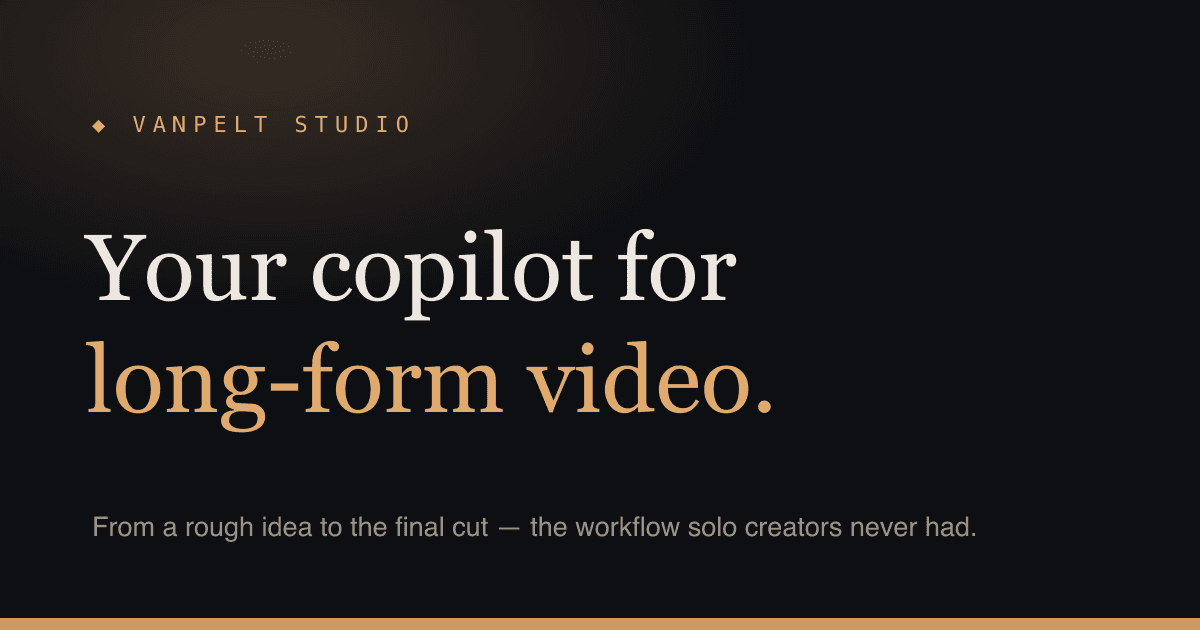
A video production team for $29 a month. A desktop app that holds the story you meant to tell and the footage you actually got, then reads one against the other.
- Year
- 2026
- Role
- Founder, solo build
- Stack
- Whisper (on-device) · ffmpeg · Claude / GPT / open models · macOS & Windows
Watch
Vanpelt Studio, the sizzle reel
The brief. A solo creator is doing the work of five people badly. Give them the part a studio would do before anyone touches a timeline, without their footage ever leaving their machine.
What it is
Vanpelt Studio is a desktop app for solo YouTube creators. It holds the story you meant to tell and the footage you actually got, then reads one against the other.
Shorts are an editing problem. The eight, fifteen and thirty-minute videos are a structure problem, and structure is where a solo creator has nobody to lean on. The weeks do not go into cutting. They go into deciding what the video is, hunting through footage, and finding the missing shot too late.
The loop
- Write the list 30%
- Every line you need to say and every shot you need to get, written down before you roll instead of re-decided twice afterwards. About an hour.
- Drop the footage in 20%
- Point at the card. Everything is transcribed and indexed locally, so a moment is something you search for rather than scrub for. Minutes, not evenings.
- See what is missing 50%
- Your list, graded against what the card actually holds. Holes surface while a pickup is still a twenty-minute job, not on day twelve when they cost the week.
The third step is the product. The first two exist to make it possible. Knowing on the same evening that two lines are missing, and that both are fixable in one short pickup, is the difference between a video that ships in three days and one that drags for three weeks.
Priced as a team, not as a tool
The framing that made the product legible was to stop describing features and start describing the roles a creator is missing. A studio would put five people on a long-form video before anyone opened an editor.
Before you shoot
- Writer: turns the idea into a beat sheet, a script and a shot list
- Packaging: drafts titles and thumbnails, and pressure-tests them before you publish
After you shoot
- Assistant editor: transcribes and indexes every clip on your machine
- Story editor: checks the footage against the plan, then calls it
After it airs
- Analyst: reads the retention graph and names the exact beat that lost them
That framing also fixed the pricing conversation. Against the cost of hiring any one of those roles, a single monthly number stops being a line item to justify.
Local-first, by design
Your footage never leaves your machine. Transcription runs on device with Whisper, ffmpeg handles the media, and only derived text, meaning transcripts and the beat sheet rather than raw media, is sent to a model for reasoning.
This is not only a privacy position. It is what makes the assistant-editor role affordable at all: indexing a full memory card by uploading it is slow and expensive, and indexing it locally is neither.
How it is built
- Desktop app. macOS and Windows.
- Transcription. Whisper, entirely on device, bundled, nothing to install.
- Media pipeline. ffmpeg, local.
- Reasoning. Claude, GPT or open models, fed derived text only.
Two ways to pay for the AI
The beta shipped bring-your-own-key only, which was the right call for early adopters and the wrong one for everyone else. Most creators do not want to create an API account to try a video app. So the managed option became the default and the key stayed as the cheaper alternative.
- Studio, $29 a month. Everything the app does with the AI built in. No key, no separate subscription, no setup. A monthly allowance sized for steady weekly output, with top-up packs in the app if you run long.
- Bring your own AI, from $12 a month. The same app and every feature, running on the Claude or ChatGPT subscription you already pay for, or on your own Anthropic or OpenAI key. Nothing marked up. Monthly starts with seven days free, annual is $120, and there are fifty founding lifetime seats at $89 once.
What shipped alongside it
Two things came out of making the channel's own videos and are now free on the studio site: an eleven-module creator course and a LUT pack built from scratch and licensed for monetised use. The LUT page collected 300 email addresses in its first week.
Both exist for the same reason the app does. The studio makes videos, the videos surface problems, the product solves them, and whatever the process leaves behind gets given away. The horror short is the clearest example of that loop closing.
Status
Shipped and downloadable, with pricing on the pricing page and a twenty-minute walkthrough offered before you buy rather than after. Client work at this studio is planned in the same app, which means the process being sold is the process actually used.
Want something like this built for you?